
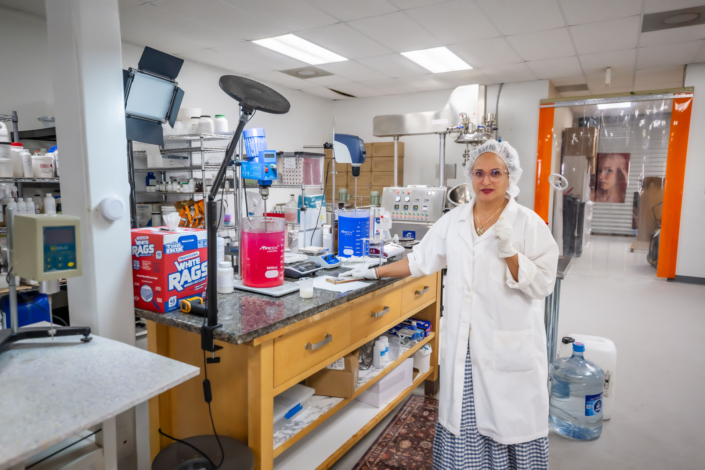
By Maya Williams
Cosmetic Chemist | Founder of Morganna’s Alchemy
“The purpose of brightening skincare should never be to erase your natural skin tone. It should be to help restore the healthy, even complexion that environmental stress, hormones, inflammation, and time have gradually taken away.”
— Maya Williams
Every year, millions of women invest hundreds—even thousands—of dollars trying to fade dark spots.
They purchase vitamin C serums, retinoids, kojic acid creams, niacinamide, chemical peels, lasers, hydroquinone, and countless products that promise brighter, more even-looking skin.
For some women, those products work beautifully.
For many others, the story is very different.
The dark spots fade…only to return.
New discoloration appears after a breakout.
A tiny scratch leaves behind a mark that lasts for months.
Sunspots become more noticeable after menopause.
The complexion gradually loses the clarity and luminosity it once had.
Understandably, many women begin asking the same question:
“Why won’t my pigmentation go away?”
For decades, the answer from dermatology was remarkably simple.
Use hydroquinone.
Hydroquinone became known as the gold standard for treating hyperpigmentation because it effectively reduces melanin production. It has helped millions of patients living with melasma, post-inflammatory hyperpigmentation, and solar lentigines when used appropriately under medical supervision.
There is no denying its importance.
But over the last twenty years, our understanding of pigmentation has undergone a scientific revolution.
Researchers now know that a dark spot is not simply the result of one enzyme producing too much melanin.
Instead, pigmentation develops through an extraordinarily complex network involving:
In other words…
Pigmentation is not one biological event.
It is an entire conversation taking place inside the skin.
That realization has fundamentally changed how cosmetic chemists formulate modern brightening products.
Instead of asking:
“How do we stop melanin?”
Today’s question is:
“How do we restore balance to the entire pigmentation process while protecting the skin from the stresses that trigger excess pigment in the first place?”
That single shift in thinking changes everything.
It changes how we formulate.
It changes how we educate consumers.
Most importantly…
It changes the future of skincare.
As a cosmetic chemist, one of the questions I hear most often is:
“What’s the best ingredient for dark spots?”
Most people expect me to answer with a single ingredient.
Hydroquinone.
Vitamin C.
Niacinamide.
Tranexamic acid.
Kojic acid.
Alpha arbutin.
Resveratrol.
But science rarely works that way.
The truth is that no ingredient exists in isolation.
Every active ingredient has strengths.
Every active ingredient has limitations.
Some are better suited for physician-directed medical treatment.
Others are ideal for long-term cosmetic maintenance.
Understanding the difference is one of the most important decisions you can make for your skin.
This article is not an attack on hydroquinone.
Hydroquinone remains one of dermatology’s most effective prescription treatments for specific pigmentation disorders.
Instead, this is an exploration of how pigmentation science has evolved—and why cosmetic researchers are increasingly focusing on ingredients that support multiple biological pathways rather than relying on a single mechanism alone.
Along the way, we’ll examine:
Whether you’re a skincare enthusiast, an esthetician, or someone who simply wants to understand why your dark spots seem so persistent, my hope is that this guide gives you something more valuable than another product recommendation.
I hope it helps you understand your skin.
Because once you understand why pigmentation develops, you can finally begin making decisions based on science instead of marketing.
If you’ve ever looked in the mirror and wondered why one small blemish left a mark that lingered for months, you’re not alone.
Hyperpigmentation is one of the most common cosmetic skin concerns worldwide. It affects people of every ethnicity and skin type, but it is especially common in women and in individuals with Fitzpatrick skin types III through VI.
Yet despite its prevalence, hyperpigmentation is often misunderstood.
Many people think of a dark spot as a stain sitting on the surface of the skin that simply needs to be scrubbed, peeled, or bleached away.
In reality, every dark spot represents a carefully orchestrated biological response.
Melanin—the pigment responsible for the color of our skin, hair, and eyes—is not produced by accident. It is manufactured by specialized cells called melanocytes, which reside in the deepest layer of the epidermis. Their primary role is not cosmetic; it is protective.
Melanin acts as one of the body’s natural defense systems against environmental damage. When ultraviolet radiation reaches the skin, melanocytes respond by increasing melanin production. That melanin is then packaged into tiny structures called melanosomes and transferred to neighboring keratinocytes, where it forms a microscopic shield over the cell nucleus to help protect DNA from UV-induced injury.
This process is elegant, efficient, and essential.
Without melanin, human skin would be far more vulnerable to photoaging and DNA damage.
The problem begins when the skin receives repeated signals that stimulate melanocytes beyond what is necessary.
Years of cumulative sun exposure.
Hormonal changes.
Acne.
Inflammation.
Pollution.
Visible blue light.
Even a mosquito bite.
Each of these can trigger melanocytes to produce excess pigment.
Sometimes that pigment fades as the skin naturally renews itself.
Sometimes it doesn’t.
The result is what we recognize as:
Although these conditions appear similar, they do not all develop through exactly the same biological pathways. That is one reason why a product that works beautifully for one type of pigmentation may produce disappointing results for another.
Understanding the origin of the pigmentation is just as important as choosing the ingredient used to address it.
One of the biggest misconceptions I encounter is the idea that melanin is something we should eliminate.
Nothing could be further from the truth.
Melanin is one of the most remarkable protective molecules in the human body. It helps shield our DNA from ultraviolet radiation, contributes to our skin’s resilience, and is an essential part of what makes every complexion unique.
When I formulate a brightening product, my goal is never to suppress healthy melanin.
My goal is to help calm the biological signals that lead to excess or uneven pigmentation while respecting the skin’s natural defenses.
That philosophy is the foundation of Morganna’s Express.
The next chapter will cover:
We’ll explore:
$60.00 — or subscribe and save 15%
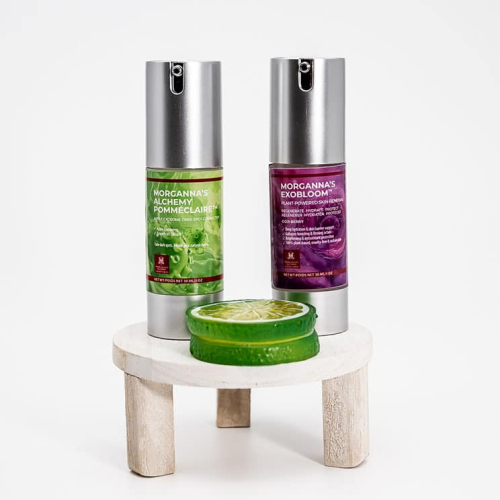
$160.00 — or subscribe and save 15%

$55.00 — or subscribe and save 15%

$200.00 — or subscribe and save 15%
$39.99 — or subscribe and save 15%

$55.00 — or subscribe and save 15%
© Copyright 2025 | All Rights Reserved | Morganna’s Alchemy Laboratories | Privacy Policy


