
here is a moment many women recognize.
Your ponytail doesn’t feel quite as thick as it used to. Your part seems wider. You begin seeing more scalp when you style your hair. Maybe there is more hair in your brush or shower drain.
And you start asking:
What is happening to my hair?
For women in their 40s, 50s and beyond, changes in hair density can become especially noticeable as aging, stress, hormonal changes, menopause, oxidative stress and changes in scalp condition begin to converge.
At Morganna’s Alchemy, we wanted to approach this differently.
We didn’t want to create another product that simply coated the hair and made it temporarily feel thicker.
We wanted to go to the source.
The scalp. The follicle. The environment where every strand begins.
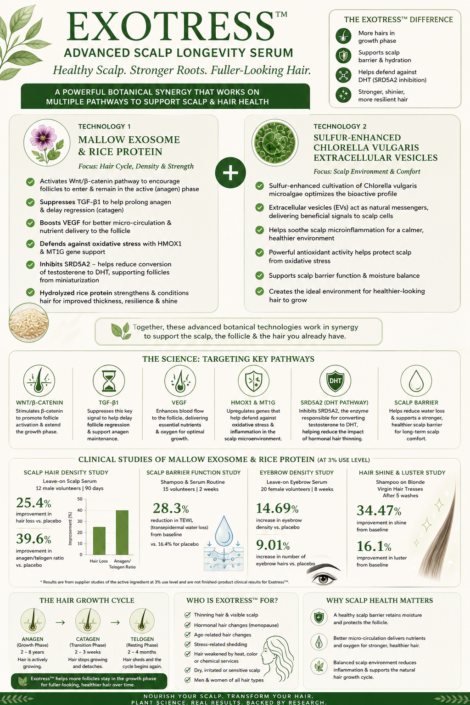
That is why we created Exotress™ Advanced Scalp Serum, combining two sophisticated botanical technologies:
Mallow exosome + hydrolyzed rice protein
and
Sulfur-enhanced Chlorella vulgaris extracellular vesicles
Together, they allow us to approach thinning-looking hair from several directions at once: supporting the natural hair-growth cycle, helping maintain a healthier scalp environment, addressing pathways associated with DHT, supporting the scalp barrier, helping calm microinflammation and strengthening the hair you already have.
This is scalp care taken seriously.
We spend enormous amounts of time talking about skin health.
We talk about the skin barrier.
Inflammation.
Oxidative stress.
Hydration.
Cellular communication.
Environmental damage.
Then we reach the hairline and suddenly stop having that conversation.
But your scalp is skin.
And embedded within that skin are thousands of highly active hair follicles.
A follicle doesn’t simply manufacture hair independently of everything happening around it. Its behavior is influenced by its biological environment and the natural hair-growth cycle.
So if we want healthier-looking, fuller-looking hair, caring for the scalp is a logical place to begin.
That became the philosophy behind Exotress:
One of the cornerstone technologies in Exotress combines mallow-derived plant exosome technology with hydrolyzed rice protein.
Mallow—or Malva sylvestris—has a long history of botanical use, particularly when comfort and soothing are desired.
But this is much more sophisticated than simply adding a traditional botanical extract to a hair serum.
The technology is designed around the communication pathways associated with the hair follicle.
Its research looks at several important biological signals:
Wnt/β-catenin
TGF-β1
VEGF
HMOX1 and MT1G
and particularly interesting for thinning hair:
SRD5A2 and DHT.
Let’s make that science understandable.
Each follicle repeatedly moves through different stages.
Anagen is the active growth stage and can last for years.
This is where we want a healthy proportion of our follicles to be.
The follicle then enters a relatively brief transition stage called catagen.
Active growth begins slowing.
Telogen is the resting stage.
Eventually the existing hair sheds and, under normal circumstances, the follicle prepares to begin another cycle.
That means seeing some hair in your brush is normal.
The question is not simply:
“Am I shedding?”
A more interesting question is:
“What proportion of my follicles are actively growing compared with resting?”
That is the anagen-to-telogen balance.
And this is where the science behind mallow exosome + rice protein becomes particularly interesting.
One of the pathways associated with initiating and maintaining the active hair-growth phase is called Wnt/β-catenin.
You don’t have to remember that name.
Think of it as part of the follicle’s biological signaling system that says:
The mallow exosome + rice protein technology has been shown in ingredient research to activate the Wnt/β-catenin pathway and stimulate β-catenin within hair-follicle cells.
That matters because supporting anagen isn’t simply about making the hair shaft look thicker.
We’re thinking about the biology surrounding the follicle itself.
If Wnt/β-catenin is associated with encouraging growth, another signal—TGF-β1—plays a role in moving the follicle away from active growth and toward regression.
The mallow exosome + rice protein technology has demonstrated suppression of TGF-β1 in ingredient research.
In simpler terms, the strategy is beautifully complementary:
Support the signal associated with active growth while helping delay the signal associated with leaving the growth phase.
This is one reason we find this technology so compelling for Exotress.
You have probably heard the letters DHT if you’ve ever researched thinning hair.
DHT stands for dihydrotestosterone.
It is an androgen produced when testosterone is converted through the action of an enzyme called 5-alpha-reductase.
One gene associated with that process is SRD5A2.
Why does this matter?
In genetically susceptible hair follicles, DHT signaling is strongly associated with progressive follicular miniaturization.
Think of miniaturization as the follicle gradually producing a smaller product.
A robust hair can become finer.
The next hair may be finer still.
Eventually the difference becomes visible as reduced density, a wider-looking part or areas where more scalp can be seen.
This mechanism is particularly well known in patterned hair thinning.
That is very interesting to us as formulators.
But it is also important to understand what we are—and are not—saying.
Exotress is a cosmetic scalp serum, not a pharmaceutical DHT-blocking treatment.
We are not claiming that Exotress treats androgenetic alopecia or that it should replace medical treatments.
Instead, we selected an ingredient whose biological research makes sense for the environment we are trying to support.
That is a very different—and much more responsible—claim.
This is important.
Hair thinning is complicated.
DHT isn’t the only factor.
Hormonal changes, age, genetics, stress, nutritional status, illness, styling damage, scalp-barrier condition and inflammation can all contribute to changes in how our hair looks and behaves.
That is exactly why we did not want Exotress to be a one-pathway formula.
And this brings us to the second major technology in Exotress.
Exotress also contains extracellular vesicles derived from the microalgae Chlorella vulgaris, cultivated using a sulfur-enhanced approach.
This brings another dimension to the formula.
If the mallow exosome + rice protein technology allows us to focus heavily on the hair cycle and density pathways, the Chlorella extracellular vesicle technology helps us focus on something equally important:
Chlorella vulgaris is a microscopic green freshwater alga.
Microalgae are fascinating organisms because they produce a wide range of biologically active substances while adapting to changing environmental conditions.
But what interests us most for Exotress isn’t simply the algae itself.
It’s what the algae releases:
extracellular vesicles.
Extracellular vesicles are microscopic lipid-bound structures naturally released by living cells.
You can think of them as tiny biological packages.
Instead of being an inert botanical extract simply sitting on the surface, extracellular vesicles are part of the way living systems transport and communicate biological information.
This concept is generating enormous scientific interest.
Research has now directly characterized extracellular vesicles produced by Chlorella vulgaris, including their lipid-bilayer structure.
For Morganna’s Alchemy, this represents an exciting intersection:
We’re taking something produced by a microscopic plant-like organism and incorporating that technology into a sophisticated scalp formula.
Sulfur has an interesting relationship with hair.
Hair is largely composed of keratin, a structural protein whose strength is closely related to sulfur-containing amino acids and the disulfide bonds that help give keratin its structure.
That doesn’t mean applying sulfur to your scalp simply “makes hair grow.”
Biology isn’t that simple.
The sulfur-enhanced cultivation of the Chlorella used for Exotress is about influencing the biological environment of the microalgae and the compounds associated with the resulting technology.
It gives us another botanical-biotechnology tool for approaching scalp vitality rather than simply treating the visible hair shaft.
One of the concepts behind our Chlorella technology is helping address scalp microinflammation.
Microinflammation isn’t necessarily the dramatic redness or irritation you immediately notice.
It can refer to lower-level inflammatory activity occurring within the scalp environment.
And this matters because the hair follicle doesn’t exist in isolation.
It sits within living tissue.
When the environment surrounding the follicle is repeatedly challenged by oxidative stress and inflammatory signaling, it may become less supportive of optimal hair and scalp function.
Think about what the scalp experiences:
UV exposure.
Pollution.
Sweat.
Heat styling.
Chemical processing.
Hair dyes.
Product buildup.
Mechanical tension.
Hormonal changes.
And simply aging itself.
That is why Exotress isn’t formulated with the philosophy:
“Force the hair to grow.”
Our philosophy is:
Oxidative stress is another piece of the puzzle.
Free radicals are produced naturally in our bodies, but excessive oxidative stress can occur when the balance between reactive molecules and our antioxidant defenses becomes disrupted.
We talk about this constantly in facial skincare because oxidative stress contributes to visible skin aging.
The scalp deserves the same consideration.
Modern research into Chlorella vulgaris extracellular vesicles is particularly interesting because it demonstrates that these vesicles are biologically active rather than simply inert particles.
That is why we see microalgae extracellular-vesicle technology as an exciting new frontier for sophisticated scalp care.
This is what makes Exotress different.
We didn’t choose one trendy ingredient and expect it to solve everything.
helps us address the hair-growth environment, including pathways associated with:
help us approach the scalp environment, particularly our focus on:
And then the formula itself has to bring those technologies together in a way that makes sense for regular scalp application.
That’s formulation.
One ingredient doesn’t make a great product. The entire formula has to work together.
We believe consumers deserve science—but science should be understandable.
Research on the mallow exosome + rice protein technology has produced some compelling results.
In a 90-day scalp evaluation, a leave-on serum containing the technology produced a:
and a:
Why do we particularly like the second number?
Because it brings us back to the hair cycle.
It suggests an improvement in the balance between hairs in the active growth stage and hairs in the resting stage.
The technology has also been evaluated for scalp-barrier function, visible density and the quality of the hair fiber.
We don’t need twenty graphs to explain why we chose it.
The important point is that we selected it because there is measurable research behind the biology we’re targeting.
These figures come from testing of the mallow exosome + rice protein technology rather than a finished-product clinical study of Exotress.
While we’re thinking about follicles and scalp biology, we haven’t forgotten the actual hair.
Hydrolyzed rice protein helps support the feel, strength and appearance of fragile hair.
That’s important.
If your hair is becoming finer, you don’t only want to think about tomorrow’s hair.
You want to protect the hair you have today.
Rice protein helps hair feel stronger and more resilient while contributing to the appearance of fuller, healthier hair.
The technology has also demonstrated improvements in hair shine and luster.
So Exotress isn’t only about what may be happening beneath the surface.
It’s also about helping the hair you can see look beautiful.
Hair changes can be particularly emotional for women.
Especially during perimenopause and menopause.
You may have spent decades knowing exactly how to style your hair—and suddenly it behaves differently.
It feels finer.
It doesn’t hold volume the same way.
The scalp becomes more visible.
And sometimes you don’t recognize the hair looking back at you in the mirror.
We don’t believe the answer is to tell women:
“That’s just aging.”
Aging is biology.
And biology can be understood.
Our job as formulators is to understand those changes and formulate intelligently around them.
Exotress doesn’t promise to turn back time.
It gives you a sophisticated way to care for the scalp and hair you have now.
Exotress was created for women and men concerned about:
And it is particularly appropriate for someone who wants to move beyond simply making thin hair look thicker for a few hours.
Apply Exotress directly to the scalp, concentrating on areas where thinning or reduced density is most noticeable.
Part the hair so the product reaches the skin rather than remaining primarily on the hair shaft.
Massage gently into the scalp.
Leave on.
And most importantly:
Hair biology doesn’t operate on TikTok time.
The hair cycle is measured in weeks, months and years.
Take a photograph when you begin.
Keep the lighting, part and angle consistent.
Then give your scalp routine time.
The beauty industry has spent decades teaching us to look at our ends.
Condition them.
Oil them.
Smooth them.
Repair them.
And yes, those things matter.
But if your concern is thinning, we need to travel in the opposite direction.
Back up the strand.
Past the root.
To the follicle.
To the scalp.
To the biological environment surrounding it.
That’s where the Exotress story begins.
With mallow exosome + rice protein, we’re looking at hair-cycle signaling, density, strength and the DHT-related SRD5A2 pathway.
With sulfur-enhanced Chlorella vulgaris extracellular vesicles, we’re expanding the conversation to scalp microinflammation, oxidative stress and the biological environment surrounding the follicle.
It is a more complete philosophy of hair care.
Not simply:
What can we put on the hair?
But:
That is Exotress.
Nourish the scalp. Support the roots. Strengthen the hair.
Because healthier-looking hair begins at the root.
$60.00 — or subscribe and save 15%
$160.00 — or subscribe and save 15%

$55.00 — or subscribe and save 15%

$200.00 — or subscribe and save 15%
$39.99 — or subscribe and save 15%

$55.00 — or subscribe and save 15%
© Copyright 2025 | All Rights Reserved | Morganna’s Alchemy Laboratories | Privacy Policy


