
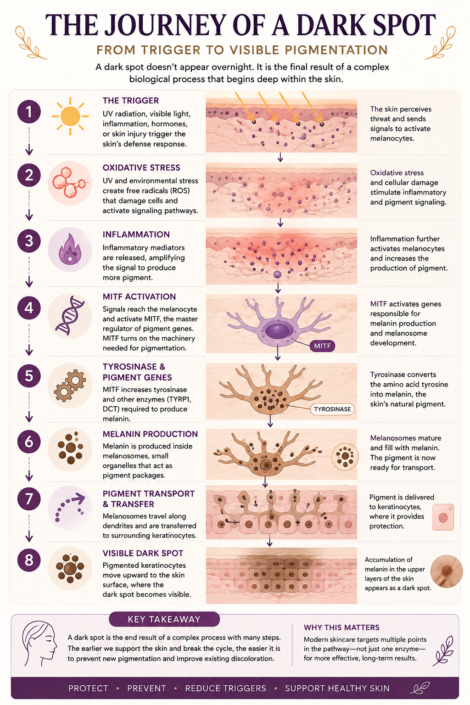
Have you ever wondered what actually happens between the moment sunlight touches your face and the moment, weeks or months later, you notice a new brown spot in the mirror?
A dark spot doesn’t simply appear.
It is the end result of an extraordinarily sophisticated biological process involving light, oxidative stress, inflammation, cellular communication, gene activation, pigment production, pigment packaging and finally pigment transfer.
And understanding that journey changes the way we should approach hyperpigmentation.
For decades, pigmentation treatment concentrated heavily on one enzyme: tyrosinase.
Tyrosinase is unquestionably important. But modern research has revealed that it represents only one stage in a much larger process.
Think of pigmentation as a production line.
If we only address one machine on that production line while all the signals upstream continue telling the skin to make more pigment, we may be missing much of the story.
So let’s follow a dark spot from beginning to end.
Pigmentation usually begins with a trigger.
The most familiar trigger is sunlight.
But melanocytes can also respond to:
When skin perceives environmental stress, pigmentation is not necessarily a malfunction.
In many circumstances, it is a protective response.
Melanin absorbs and dissipates portions of ultraviolet radiation, helping protect cellular DNA from photodamage.
So when UV radiation reaches the skin, the skin essentially receives a message:
We need more protection.
That message begins a cascade of events eventually leading melanocytes to produce more melanin.
This is the first important lesson in understanding hyperpigmentation:
The dark spot is not where the story begins.
It begins much earlier—with the signal telling the skin that more pigment is needed.
When ultraviolet radiation interacts with skin cells, it can generate reactive oxygen species (ROS).
You may know them by their more familiar name:
free radicals.
Reactive oxygen species are chemically reactive molecules that can interact with:
In healthy skin, antioxidants help neutralize these reactive molecules.
But when environmental exposure overwhelms the skin’s antioxidant defenses, we enter a state known as oxidative stress.
And oxidative stress doesn’t simply contribute to wrinkles.
It can also influence pigmentation.
ROS and UV-related cellular damage can stimulate inflammatory and signaling pathways that communicate with melanocytes.
This is why I consider antioxidants an important part of modern pigmentation care.
If we focus only on pigment after it has already been produced, we’re addressing the end of the process.
Supporting the skin against oxidative stress means addressing something much further upstream.
This is one of the biggest changes in the way I think about pigmentation as a formulator.
I don’t only ask:
“What can reduce pigment?”
I also ask:
“What is telling this melanocyte to keep producing pigment?”
If oxidative stress and inflammatory signaling are part of that conversation, then antioxidant support becomes part of the pigmentation strategy—not simply an anti-aging bonus.
That distinction was extremely important when I formulated Morganna’s Express.
A melanocyte doesn’t simply decide on its own to manufacture more pigment.
It receives instructions.
One important pigmentation signaling pathway involves alpha-melanocyte-stimulating hormone, or α-MSH.
α-MSH interacts with a receptor on melanocytes called MC1R, or melanocortin-1 receptor.
Think of α-MSH as the message and MC1R as the receiver.
Once that message is received, a series of intracellular events begins.
One of the most important consequences is activation of a master pigmentation regulator called:
or microphthalmia-associated transcription factor.
MITF is extremely important because it helps control the expression of several genes required for melanogenesis.
These include genes associated with:
MITF is therefore much more than another pigmentation enzyme.
Think of it as a manager of the pigment factory.
Once MITF activity increases, melanocytes receive instructions to increase the machinery required for pigment production.
And only now do we arrive at the molecule most consumers have heard about.
Tyrosinase.
Tyrosinase is one of the most important enzymes in melanin production.
It catalyzes early reactions that convert the amino acid tyrosine toward compounds that ultimately form melanin.
This is why so many traditional brightening ingredients focus on tyrosinase.
Hydroquinone.
Kojic acid.
Arbutin.
Vitamin C derivatives.
Many pigmentation ingredients attempt, through different mechanisms, to reduce tyrosinase activity or interfere with melanogenesis.
And that approach makes biological sense.
If you slow down a critical enzyme in pigment production, you can reduce the amount of pigment produced.
But now we can see why tyrosinase is not the entire story.
Before tyrosinase became active, several things had already happened:
Environmental exposure
↓
Oxidative stress
↓
Cellular signaling
↓
α-MSH / MC1R
↓
MITF activation
↓
Pigmentation-associated gene expression
↓
Tyrosinase
So simply inhibiting tyrosinase means intervening partway through a much larger biological cascade.
This is one reason modern pigmentation science has become so interested in multi-target approaches.
Melanin doesn’t float freely inside melanocytes.
It is produced and organized inside specialized cellular structures called melanosomes.
Think of melanosomes as microscopic pigment packages.
As they mature, they accumulate melanin.
Scientists commonly describe melanosome development through several stages of maturation, from relatively immature structures to pigment-rich mature melanosomes.
This stage is especially important when discussing different skin tones.
People with different complexions do not necessarily have dramatically different numbers of melanocytes.
Much of the visible difference in skin color relates instead to melanosome characteristics, melanin type, distribution, persistence and processing within keratinocytes.
That is a critical distinction.
Darker skin isn’t simply skin with “more melanocytes.”
Its pigment system behaves differently.
And those differences are one reason hyperpigmentation can be especially persistent in richly melanated skin.
Producing melanin still isn’t enough to create the dark spot you eventually see.
The pigment must now travel.
Melanosomes move through the branching dendrites of melanocytes toward neighboring keratinocytes.
Several molecular systems participate in this transport process.
The pigment-containing melanosomes are eventually transferred from melanocytes to keratinocytes.
This is an extraordinary example of cellular cooperation.
One melanocyte communicates with numerous surrounding keratinocytes and distributes pigment among them.
Once inside keratinocytes, melanin helps form a protective arrangement around the cell nucleus.
Again, the skin isn’t doing this to annoy us.
It is trying to protect itself.
But when pigment production and transfer become excessive or uneven, that protective system becomes visible as hyperpigmentation.
Keratinocytes gradually migrate upward through the epidermis.
As they move toward the surface, they carry pigment with them.
Eventually, this pigmentation becomes visible to us as:
What appears to be a simple brown spot in the mirror is therefore the final visible result of a biological process that began much earlier.
That process looked something like this:
↓
↓
↓
↓
↓
↓
↓
↓
↓
↓
Once you see the complete pathway, something becomes obvious.
Pigmentation has many potential intervention points.
That is the foundation of modern pigmentation science.
This biology becomes especially important in Fitzpatrick skin types IV, V and VI.
A 2024 systematic review of post-inflammatory hyperpigmentation in skin of color describes PIH as particularly prevalent and persistent in darker skin tones and highlights how difficult it can be to treat once established.
Inflammation itself can stimulate pigmentation.
That creates a paradox.
If we use an overly aggressive treatment to remove a dark spot and that treatment causes significant irritation…
the irritation can potentially stimulate another pigmentation response.
This is one reason I believe pigmentation care for richly melanated skin should never simply be about finding the strongest possible treatment.
Sometimes stronger isn’t smarter.
Skin tolerance matters.
Inflammation matters.
Barrier health matters.
And photoprotection matters.
For years, conversations about pigmentation focused almost exclusively on ultraviolet radiation.
But research has expanded that picture.
Visible light—the portion of sunlight our eyes can see—can also influence pigmentation.
Research reviewed in Photochemical & Photobiological Sciences found that visible light can produce particularly persistent pigmentation in darker skin, in some experimental conditions producing more intense and longer-lasting pigmentation than UVA1. The combination of visible light and UVA1 may be particularly relevant to disorders such as melasma and PIH.
This is particularly important for women with richly melanated skin.
But there is an important distinction that often gets lost on social media:
Sunlight is the major visible-light exposure of concern.
Claims about everyday phone or computer screens producing the same pigmentation effects should not automatically be equated with controlled studies involving much stronger visible-light exposures.
That distinction matters because good skincare education should reduce unnecessary fear—not create it.
Once I understood pigmentation as an entire pathway rather than one enzyme, trans-resveratrol became much more interesting to me as a cosmetic chemist.
Because resveratrol isn’t being investigated for only one action.
Published reviews describe several potential anti-melanogenic mechanisms.
Research suggests resveratrol may influence:
Resveratrol has antioxidant activity that may help protect keratinocytes from oxidative stress and reduce signaling that can stimulate melanocytes.
Its anti-inflammatory activity may help reduce one of the upstream environments associated with pigment stimulation.
Experimental research has reported effects on MITF-related pigmentation signaling under certain conditions.
Resveratrol has been studied for both direct and indirect effects on tyrosinase, including effects on enzyme activity, expression and maturation.
Preclinical research has demonstrated reduced melanogenesis in cellular and animal models.
A particularly interesting aspect of resveratrol research involves its effects on keratinocytes. Because keratinocytes help regulate melanocyte behavior, protecting them from oxidative and inflammatory stress may indirectly influence pigmentation.
This is why calling resveratrol simply a “tyrosinase inhibitor” doesn’t tell the whole story.
Its scientific interest comes from its potential to influence pigmentation at multiple levels.
I want to be very careful here.
Much of the detailed mechanistic evidence surrounding resveratrol and pigmentation comes from cell culture, biochemical and animal research.
Those studies help us understand how an ingredient might work.
They are not the same as large, randomized human clinical trials demonstrating that a finished resveratrol skincare product will produce a specific percentage reduction in someone’s dark spots.
That’s an important distinction.
Good cosmetic science requires us to be excited by promising mechanisms without turning those mechanisms into claims the research hasn’t established.
And that’s exactly how I approach formulation.
This is why I chose trans-resveratrol for Morganna’s Express.
I wasn’t looking for another ingredient that could simply say:
“I inhibit tyrosinase.”
I wanted to look further upstream.
What about oxidative stress?
What about inflammatory signaling?
What about MITF?
What about tyrosinase production and maturation?
What about the environment surrounding the melanocyte?
And, as we explored in Chapter 3, what about the fascinating emerging relationship between resveratrol and estrogen-receptor signaling in mature skin?
No single cosmetic ingredient solves every one of these processes.
But trans-resveratrol gives us something much more interesting than a one-dimensional brightener:
a multi-target molecule.
This brings us back to the central philosophy behind this entire series.
Melanin isn’t the enemy.
Your melanocytes aren’t malfunctioning simply because they produce pigment.
They are responding to signals.
Sunlight.
Oxidative stress.
Inflammation.
Hormones.
Cellular communication.
The goal of sophisticated pigmentation care should therefore not be to wage war against melanocytes.
It should be to understand the signals influencing them and support a healthier environment in which pigmentation can become more balanced.
That is a very different philosophy from:
Bleach. Peel. Suppress. Repeat.
Instead:
↓
↓
↓
↓
↓
That is what I mean when I talk about intelligent pigmentation care.
We’ve now followed the journey of a dark spot from environmental exposure all the way to visible pigmentation.
We’ve seen that pigmentation isn’t one reaction.
It’s an interconnected network.
And we’ve discovered that trans-resveratrol may interact with several points within that network.
But we still haven’t really answered the biggest question:
What exactly is trans-resveratrol?
Why do plants make it?
Why does the trans form matter?
Why isn’t drinking red wine the same thing?
How does resveratrol interact with tyrosinase, MITF and oxidative stress?
And what does the human clinical evidence actually show?
That’s where we’re going next.
In Chapter 5, we’ll separate the fascinating science from the marketing hype—and examine exactly why I chose highly purified trans-resveratrol for Morganna’s Expres
$60.00 — or subscribe and save 15%
$160.00 — or subscribe and save 15%

$55.00 — or subscribe and save 15%

$200.00 — or subscribe and save 15%
$39.99 — or subscribe and save 15%

$55.00 — or subscribe and save 15%
© Copyright 2025 | All Rights Reserved | Morganna’s Alchemy Laboratories | Privacy Policy


