

As skincare becomes more advanced, consumers are faced with more ingredient technologies than ever before. Among the most frequently compared are plant stem cells and exosomes — two natural yet highly different approaches to supporting healthy, radiant skin.
Although both come from botanicals, each offers a completely different benefit.
And understanding the difference helps you choose products that truly transform your skin, especially if you struggle with dark spots, hyperpigmentation, wrinkles, dullness, or irritation.
Plant stem cells come from fruits, flowers, leaves, and seeds. In nature, they help plants regenerate after injury. But when used in skincare, they aren’t living cells — they’re extracts rich in:
These ingredients help defend the skin from:
✔️ Improve skin softness
✔️ Add antioxidant protection
✔️ Support resilience
✔️ Help maintain hydration
✔️ Reduce visible dullness
❌ Turn into human skin cells
❌ Deliver instructions to skin
❌ Trigger collagen production
❌ Correct dark spots directly
Plant stem cells behave like nutrients — providing nourishment and defense.
Exosomes are much smaller and far more dynamic. They are microscopic vesicles — tiny carriers that transport important molecules between cells.
Think of exosomes as the DMs of the skin: they deliver messages.
These messages include:
Plant-derived exosomes (like Apple and Goji) are especially powerful because they are clean, stable, irritation-free, and recognized easily by the skin.
Exosomes don’t just sit on top of the skin. They interact with skin cells to:
They activate pathways that stimulate collagen Types I and III — essential for firmness and elasticity.
Exosomes contain anti-inflammatory molecules that calm redness and irritation.
By communicating renewal signals, exosomes accelerate cell turnover and reduce the intensity of pigmentation.
They enhance repair mechanisms that keep moisture inside and irritants out.
After exfoliation, stress, or environmental exposure, exosomes help skin bounce back faster.
Because they act on a cellular level, improvements in texture, radiance, and tone often appear faster than with traditional ingredients.
| Benefit | Plant Stem Cells | Exosomes |
|---|---|---|
| Antioxidant protection | ✔️ | ✔️ |
| Nourishment | ✔️ | ✔️ |
| Cellular communication | ❌ | ✔️ |
| Collagen stimulation | ❌ | ✔️ |
| Dark spot correction | ❌ (indirect) | ✔️ (direct signaling) |
| Barrier repair | ❌ | ✔️ |
| Reducing inflammation | ✔️ | ✔️ (stronger) |
| Speed of results | Slow | Faster |
| Anti-aging effect | Mild | Strong |
They strengthen and protect.
They tell your cells to regenerate, brighten, and renew.
At Morganna’s Alchemy, we selectively choose ingredients that offer:
Plant exosomes are superior for customers looking to improve:
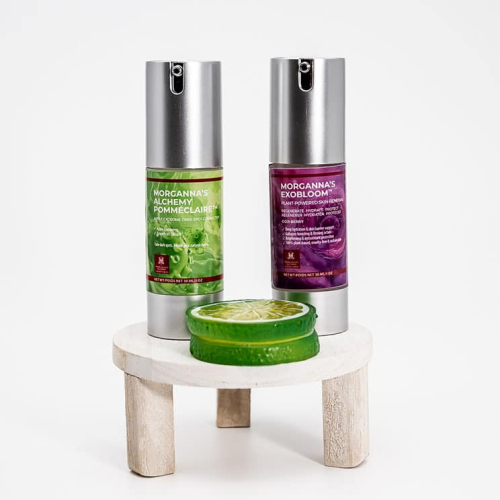
This is why our breakthrough formulas — ExoBloom™ and PommeClaire™ — rely on exosome communication, not just antioxidant support.
Your skin deserves more than protection.
It deserves transformation.
$60.00 — or subscribe and save 15%
$160.00 — or subscribe and save 15%

$55.00 — or subscribe and save 15%

$200.00 — or subscribe and save 15%
$39.99 — or subscribe and save 15%

$55.00 — or subscribe and save 15%
© Copyright 2025 | All Rights Reserved | Morganna’s Alchemy Laboratories | Privacy Policy


