
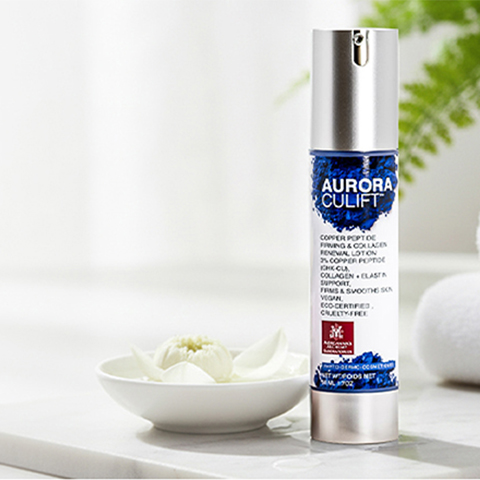
As a cosmetic chemist, I’ve learned that the most powerful ingredients are rarely “trendy.” They’re usually the molecules our bodies already know how to use. GHK-Cu—Copper Tripeptide-1—is one of those rare ingredients. It isn’t a synthetic trick or a cosmetic illusion; it’s a biological signal your skin has relied on since the day you were born.
This blog unpacks the science behind GHK-Cu, how it works inside the skin, and why it became the heart of Morganna’s Aurora CuLift.
GHK-Cu is a naturally occurring human tripeptide made of three amino acids—glycine, histidine, and lysine—that binds to a copper ion to form a powerful complex. Scientists have identified this molecule in human plasma and in proteins involved in inflammation and repair such as collagen and fibrinogen.
At age 20, our bodies contain roughly 200 µg/mL of GHK-Cu.
By age 60, that level drops to around 80 µg/mL.
This decline mirrors what many of us see in the mirror:
GHK-Cu acts as a biological instruction manual. When it binds with copper (Cu²⁺), it activates enzymes responsible for:
It also regulates free copper ions to prevent oxidative stress, keeping the system balanced rather than reactive.
Think of GHK-Cu as a conductor of an orchestra. Instead of targeting one single symptom, it coordinates multiple repair pathways at once.
GHK-Cu has been shown to reduce inflammatory messengers such as IL-6 and TNF-alpha, two major drivers of “inflammaging.” Calmer skin heals better and ages slower.
It stimulates both fibroblasts and keratinocytes, encouraging faster turnover and healthier epidermal structure.
By promoting new blood vessel formation, GHK-Cu improves oxygen and nutrient delivery to the dermis—essential for vibrant, resilient skin.
Research suggests it helps guide skin back toward a younger gene expression pattern, almost like reminding the skin how it used to behave.
GHK-Cu increases synthesis of:
This is why the peptide is often described as a “reset signal” rather than just an anti-wrinkle ingredient.
GHK-Cu is one of the most studied peptides in dermatology. The body of research shows it can:
In medical models, GHK-Cu accelerated ulcer closure from 60.8% to 98.5% and lowered infection rates from 34% to 7%. That tells us something important: this molecule doesn’t just “beautify” skin—it supports real tissue repair.
Comparative studies have shown GHK-Cu surpassing Vitamin C and even tretinoin in several structural parameters like skin density and elasticity—without the irritation many people experience from retinoids.
Free GHK on its own is fragile. Research shows:
When it complexes with copper, everything changes:
The copper remains “biologically silent” until it reaches target cells, making the complex both effective and safe.
Used correctly, GHK-Cu is gentle enough for long-term daily application, even for sensitive and menopausal skin.
When I formulated Aurora CuLift, I wasn’t looking for a fashionable active. I wanted a molecule that could speak the same language as aging skin.
➡ Copper Tripeptide-1 (GHK-Cu)
A pharmaceutical-grade peptide identical to the one described in the HXPT Repairs012 dossier.
Aurora isn’t designed to force the skin into looking younger—it’s designed to remind the skin how to function younger.
I’ve spent over 30 years in the lab, and one truth remains:
Skin doesn’t need punishment—it needs guidance.
GHK-Cu provides that guidance. It works with biology instead of against it, which is why it became the cornerstone of Morganna’s Aurora CuLift.
Aging skin isn’t broken.
It’s simply missing a message—and Copper Tripeptide-1 delivers it.
— Maya, Cosmetic Chemist & Founder
Morganna’s Alchemy
$60.00 — or subscribe and save 15%
$160.00 — or subscribe and save 15%

$55.00 — or subscribe and save 15%

$200.00 — or subscribe and save 15%
$39.99 — or subscribe and save 15%

$55.00 — or subscribe and save 15%
© Copyright 2025 | All Rights Reserved | Morganna’s Alchemy Laboratories | Privacy Policy


